
Superior Fluid Solutions · Cross-Reference
LET-LOK® vs Swagelok®: The Port End Is Half the Fitting
The tube end gets measured first. The port end is what actually decides whether a fitting threads into your instrument, manifold or valve body.
A tube fitting is usually described by its tube size alone, a quarter inch here, a 6 mm there, while the pipe or port end on the other side of the body is a separate decision with its own standard, its own letter code and its own way of holding pressure. According to Swagelok®’s own pipe fittings catalog, MS-01-147, a manufacturer publication, its “NPT threads are based on requirements of ASME B1.20.1 and SAE AS71051,” and its parallel and straight-thread families answer to different standards again. Ham-Let®, which sells its compression tube fittings as LET-LOK®, splits its own port pressure tables along the same lines, one table per thread family. Telling those families apart on a drawing you did not draw is what this post covers. Tube outside diameter, and the inch-versus-millimetre problem, belong to a different discussion.
Two ways a port can seal
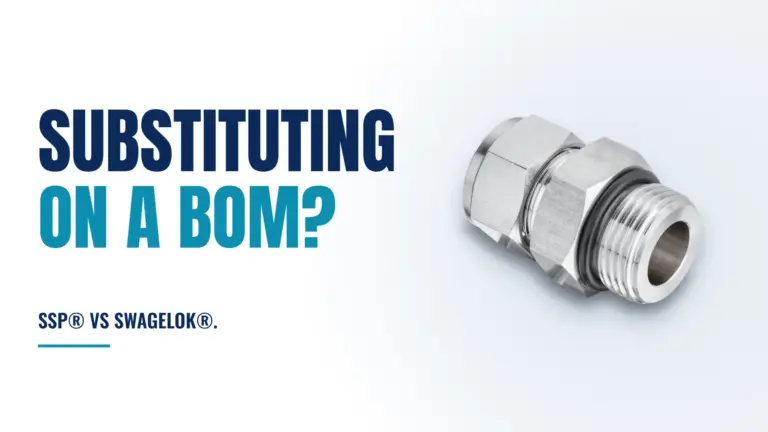
Every pipe or port thread falls into one of two camps, and the international standards are named after the difference. A tapered thread makes the joint on the thread itself: the flanks wedge as the connection is tightened, which is why tapered work usually carries sealant. A parallel thread does not. ISO 228-1 is titled, in full, “Pipe threads where pressure-tight joints are not made on the threads,” and the standard describes threads intended for mechanical assembly, with the pressure-tight seal made outside the thread by compressing a separate seal between two surfaces. Swagelok®’s catalog shows that principle in hardware: its “RP and RS fitting copper gasket provides a seal with male ISO/BSP parallel threads,” and its SAE and MS straight-thread adapters use an O-ring instead, which the catalog specifies as “90 durometer fluorocarbon FKM.” Ham-Let®’s LET-LOK® catalog publishes both camps side by side, with separate pressure tables for tapered NPT and ISO 7 ports, for parallel ISO/BSPP ports, and for SAE J1926 O-ring boss ends. Sorting a port into the right camp, before anyone reaches for a size, is most of the identification work.
Reading the designation letters on a drawing
Each company gives its port families a short code, and the codes do not line up between them. That is the sort of detail that quietly falls off a drawing as it passes from hand to hand. Ham-Let®’s LET-LOK® catalog marks the tapered ISO 7 form with an R, the parallel ISO/BSPP form with a G, and its O-ring boss end as LOB under SAE J1926. Swagelok® uses a different vocabulary entirely: RT for its tapered ISO/BSP line under ISO 7, RS and RP for its parallel ISO/BSP fittings under ISO 228, and ST and STH for its SAE and MS straight-thread lines, with ASME B1.1 named as the thread standard behind them. A letter on one company’s data sheet is only that company’s letter. Neither set is a universal key, and neither can be assumed to carry over to a third brand’s stamping.
| Thread family | Where the pressure seal is made | Ham-Let® LET-LOK® catalog | Swagelok® catalog |
|---|---|---|---|
| NPT tapered | On the thread | Its own NPT pressure table | NPT, per ASME B1.20.1 |
| ISO 7 tapered | On the thread | Coded R | RT fittings, per ISO 7 |
| ISO 228 parallel | Off the thread, at a gasket | Coded G | RS and RP fittings, copper gasket |
| Straight thread, O-ring boss | Off the thread, at an O-ring | LOB, per SAE J1926 | ST and STH fittings, FKM O-ring |
Each column shows only what that company publishes for the family in that row. A row appearing in both columns means both companies build to the same recognised thread standard. It does not mean parts from the two columns belong in one joint.
Why the port end leads and the fitting follows
On almost every job the port exists before anybody chooses a fitting. It was drilled and tapped into a valve body, an instrument boss or a manifold block, and nobody is going to re-cut it to suit what happens to be in the van. So the port thread family is the first thing to establish on an existing installation, ahead of tube size, ahead of brand, ahead of everything. Drive a parallel BSPP fitting at a tapered NPT port, or the reverse, and it will not seat properly no matter who made either half, because the two forms are cut to different geometry. Three checks cover it: read the stamped size and any letter beside it, put a thread gauge on anything illegible, and work out whether the existing joint is sealing on the thread or at a separate gasket or O-ring face. Do those three before a single part number gets written down.
Superlok® sells its own product on one boast, the finest interior surface finish of any tube and pipe fitting on the market. Superlok®’s sentence, about Superlok®, repeated here without extension. Port ends and tube ends alike are listed in 316 stainless steel. It is corrosion-resistant enough for the wash-down bays and outdoor positions where port threads tend to live. Which thread family and which nominal size you end up with is settled per order, against the marking or the gauge reading you send us. Our pipe fittings and nipples cover the threaded side, the adapters bridge between ends, the gauge valves arrive carrying these same port threads, and our analyzer cross-reference piece works the same problem from the tube side.
Questions about port and thread ends
NPT and ISO 7 are both tapered. Does that make them the same thread?
No. They share the principle of sealing on the thread and nothing else. Each is its own standard with its own geometry, so a stamped R or an ISO 7 note should be treated as its own family and gauged accordingly.
How do I spot a parallel port by eye?
A parallel thread holds one diameter end to end; a tapered one visibly narrows. If the part carries a letter, Ham-Let®’s catalog uses G for parallel and R for tapered, which is worth checking against what you can actually read on the metal.
Does an O-ring boss port want thread sealant?
No. The seal on that style is made away from the thread, at an O-ring, and the thread is there to hold the parts together. ISO 228-1 is even titled for that distinction, and adding sealant does not change where the seal happens.
The size looks close. Can a BSPP fitting go into an NPT port?
No, and brand has nothing to do with it. The forms are cut differently and will not seat together. Establish the family from the stamping or a thread gauge, then order.
What do you need to cross-reference a port end?
Whatever is stamped, a gauge reading where nothing is legible, and the tube end details from the other side of the body. Family and size are confirmed per order from that.
Photograph the stamp, or gauge the thread
Thread family first, size second, part number last. That is the order we work in.
Superior Fluid Solutions
Identify the thread family. Everything else follows it.
Sources
- Swagelok, “Pipe Fittings,” MS-01-147 (manufacturer publication), supports the quoted NPT standards reference, the RT, RS, RP, ST and STH family names with ISO 7, ISO 228 and ASME B1.1 behind them, the quoted copper gasket seal for RP and RS parallel threads, and the quoted 90 durometer fluorocarbon FKM O-ring on the straight-thread adapters. swagelok.com
- Ham-Let, LET-LOK® compression tube fittings catalog (manufacturer publication), supports the R code for the tapered ISO 7 form, the G code for parallel ISO/BSPP, and the LOB O-ring boss end published under SAE J1926, each with its own pressure table. s29.q4cdn.com
- International Organization for Standardization, ISO 228-1:2000, “Pipe threads where pressure-tight joints are not made on the threads, Part 1: Dimensions, tolerances and designation,” supports the quoted title and the standard’s description of parallel fastening threads whose pressure-tight seal is made outside the thread by a compressed seal. iso.org
Technical note: the sources above establish how each named manufacturer designates and publishes its own port thread families, and how the governing parallel-thread standard describes where a pressure-tight seal is and is not made. They do not establish that a port end from one manufacturer may be assembled with a body from another, and they do not certify thread suitability for your installation. Superlok® port thread family, size and documentation are confirmed per order.
Trademark disclaimer: Swagelok® is a registered trademark of Swagelok Company. Ham-Let® and LET-LOK® are trademarks associated with Ham-Let Group, a Watts Water Technologies company. Superlok® is a registered trademark of BMT Co., Ltd. Superior Fluid Solutions is not affiliated with, authorized by, endorsed by or sponsored by any of these companies, and the marks are used here only to identify the products they name. Cross-references are made by form, fit, and function only.