
SUPERIOR FLUID SOLUTIONS · PORTING GUIDE
Ordering a 3-Way Plug Valve
How L-port and T-port porting differ, what Superlok® lists today, and what to send us when you need three ports.
If you are searching for a 3 way plug valve, start with one plain fact: the Superlok® models on our plug valves category page are two-port valves, one inlet and one outlet, and nothing we reviewed lists a third port. Our shop carries no plug valves online, so every plug valve request is quoted. According to Pumps & Systems, a trade magazine (November 2022), L-port valves are also called diverter or L-pattern valves, while T-port valves are mostly used for mixing. Knowing which one you need is the first line of a correct order.
The 3 Way Plug Valve: What Is Listed and What Is Not
We checked the Superlok® SPV and SRPV pages before writing this. The SPV130 datasheet, a manufacturer publication, labels its ports “Inlet” and “Outlet” and describes no multi-port version. The SRPV rising plug valve page describes a “straight-through flow path” and does not name a three-way or multi-port model either. Our reading is that the listed plug valves are two-way. If the maker issues a three-way version, it is not on the pages we found, and we will not suggest otherwise.
Three-way plug valves do exist as a type. Supply House Times, a trade publication (December 2002), describes special multi-port plug valves used for switching flow, and says three-way and four-way designs offer a number of switching and diverting combinations. That tells you the type is real. It does not tell you that any particular supplier lists one.
L-Port or T-Port: Choosing the Flow Pattern
Pumps & Systems explains that the letters describe the fluid path through the three ports, and that the path depends on the port configuration and on how the valve is piped. The article covers three-way valves as a group and mentions multipath plug valves only in a list of types, so treat the table as a guide to vocabulary and confirm the pattern for a plug valve against the maker’s drawing.
| Point | L-port | T-port |
|---|---|---|
| Typical job | Diverting: flow goes one way at a time | Mixing, or sending flow to two destinations |
| Port layout | Usually one inlet and two outlets | Two inlets and one outlet, or one inlet and two outlets |
| Operation | A 90 degree turn switches between outlets; a further quarter turn blocks both | With all ports open, flow runs straight through; a 90 degree turn sends the common port to one outlet |
| Shutoff | Certain designs turn 360 degrees and have two shutoff positions | Lacks bubble-tight shutoff |
If the line needs strict leakage control, say so before the pattern is chosen.
The last row matters most to buyers. A T pattern that mixes two sources is a good fit for blending and a poor one for tight isolation. If you need both mixing and isolation, name both duties on the request instead of leaving the choice to the quote.
What to Put on the Order
A three-way request that says only “3 way plug valve, 1/4 inch” will come back with questions. Send these lines instead:
- Pattern and common port. L or T, and which line is the common one. A sketch with the three lines labelled is worth more than a paragraph.
- Positions. List every handle position you need and what flows in each, including any position where all three ports must be closed.
- Duty. Divert, mix, bypass or isolate, and how often the handle moves.
- Pressure and temperature, together. The Superlok® SPV and SRPV ratings step down as temperature rises, so give both numbers. Gas service has its own checks, covered in our gas plug valve post, and we do not repeat them here.
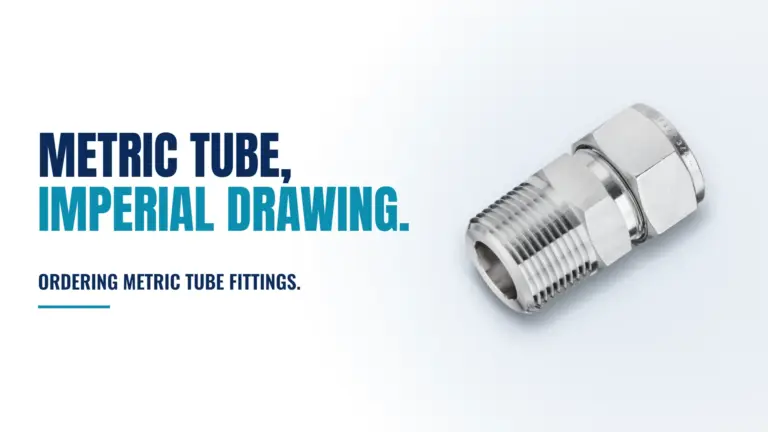
- Size and ends. Tube OD or NPT, per port. If your drawing mixes inch and metric tube, read ordering metric tube fittings from an imperial drawing first.
- Material and paperwork. State the grade, such as 316 stainless steel (the SRPV page describes its valve as constructed from corrosion-resistant stainless steel), and whether you need material test reports. Our guide to material test reports for fittings shows what to ask for.
Superlok® describes its tube fittings as having the finest interior surface finish of any tube and pipe fitting on the market. Where your three-way valve joins a tube run, the fittings can be quoted in the same request, listed in 316 stainless steel and confirmed per order.
When Another Valve Does the Job
Before you chase a three-way plug valve, check whether the duty needs one. Supply House Times says plug valves are intended mainly for on-off service and are not usually recommended for throttling. If your real need is isolation on a branch, two ball valves on a tee can do it with two clearly labelled handles. If it is fine metering, needle valves are the usual answer. Two valves cost more positions to operate and one more joint, and a single three-way handle can reduce the chance of a wrong combination. Those trade-offs are yours to weigh, and we would rather quote the alternatives than guess.
Buyer Questions on Three-Way Plug Valves
Does Superior Fluid list a three-way plug valve?
No. The shop lists no plug valves of any kind, and the Superlok® plug valve pages we reviewed describe two-port valves. Send the request form your duty and we will say plainly what can be quoted.
What is the difference between L-port and T-port?
An L-port valve diverts flow to one of two outlets at a time. A T-port valve is mostly used for mixing and can send flow to two places at once, but it lacks bubble-tight shutoff, per Pumps & Systems.
Can I use a two-way valve on each branch instead?
Often, for isolation. You get independent shutoff on each branch, at the cost of an extra handle and joint. For switching between two outlets with one motion, a single three-way is simpler.
What should I send with the request?
A labelled sketch of the three lines, the pattern, every handle position, maximum pressure and temperature, size and ends, and whether you need test reports.
Tell us the three lines and the positions
A sketch and a duty are enough for us to reply with options or an honest no.
SUPERIOR FLUID SOLUTIONS
Three ports specified once, quoted correctly.
Sources
- Pumps & Systems, Gilbert Welsford Jr., “Common Applications of Three-Way Valves,” December 2022 issue (published 15 November 2022). Supports the L-port and T-port descriptions, operation, mixing use and the bubble-tight shutoff limit; mentions multipath plug valves only in a list. qgdigitalpublishing.com
- Supply House Times (BNP Media), “College of Product Knowledge: General Application Valves Part III,” 1 December 2002. Supports the 90 degree operation, on-off service, the throttling comment and the multi-port, three-way and four-way plug valve types. supplyht.com
- Superlok North America, SPV130 series plug valve datasheet (manufacturer publication). Supports the inlet and outlet port labels and the absence of a multi-port version. superloknorthamerica.com
- Superlok North America, SRPV rising plug valves catalog page (manufacturer publication). Supports the “straight-through flow path” and corrosion-resistant stainless steel wording. superloknorthamerica.com
- Superlok North America, plug valves page and SPV catalog page (manufacturer publications). Support the 316 stainless steel body and the absence of port-count wording. plug valves, SPV
- Superior Fluid Solutions, plug valves category page (distributor publication). Supports the quote route and the absence of a three-way listing. plug valves
Technical note: The sources establish how L-port and T-port are described for three-way valves in general, that multi-port plug valves exist as a type, and that the Superlok® SPV and SRPV pages we reviewed show an inlet and an outlet and no third port. They do not establish that a three-way plug valve is unavailable from the manufacturer, which flow pattern any specific plug valve uses, or any pressure rating for a three-way plug valve. The two trade articles are dated 2022 and 2002. Grade and rating are confirmed per order.
Trademark disclaimer: Superlok® is a registered mark of its owner. Pumps & Systems and Supply House Times are named only to identify sources. Cross-references are made by form, fit, and function only.