
Superior Fluid Solutions · Spares and Consumables
Buying and Stocking Ferrule Sets: What Belongs on the Shelf
Ferrules are spares, and a spare only earns shelf space if the right set reaches the right joint.
Ferrule sets are the line on a fittings order nobody thinks about until a panel is open and the small parts on the bench no longer look right. According to a Swagelok® online product listing, which is a manufacturer publication rather than independent testing, a ferrule set is catalogued as “1 Front Ferrule/1 Back Ferrule” for a single tube size and ordered in multiples of ten. That one line carries the buying logic: ferrules are consumables, they come as matched pairs, and each pair is tied to one size and one fitting family. Mechanically the front ferrule seals against the body while the back ferrule grips the tube, and that is the only sentence needed here, because the problem worth solving is purchasing and storage.
Buy ferrules the way you buy gaskets
Bodies and nuts are hardware: bought once, fitted, left in place. Ferrules are not. They are pulled up onto the tube, take a permanent set, and every time a technician breaks that joint the pair can come off damaged, dropped or lost in the tray. The right model is the gasket drawer, a cheap fast moving item that stops a whole job when the box is empty.
Manufacturer guidance does not call them single use across the board. Swagelok® states in its installer guide that you “may disassemble and reassemble” its tube fittings “many times”, which is why most remakes reuse the ferrules already swaged onto the tube. The same guide, in one removal procedure, says plainly “Discard the ferrules.” Both are true, which is exactly why a shelf stock exists. Most remakes need nothing. The ones that do need it at the worst moment. Our note on turnaround fittings planning applies the same habit to whole assemblies.
Why they are sold as front and back sets
The two ferrules are not the same part in two sizes. They are different profiles that move against each other in a fixed sequence as the nut turns. Sold separately, a stores cupboard drifts out of balance within a year: fronts get used at a different rate to backs, someone reorders only the one that ran out, and you end up with a tray of singles that cannot make a joint. Matched pairs in packs of ten keep the count honest.
A set is also tied to one tube size. There is no ferrule that covers a range. Parker® lists its own front and back ferrule sets for its tube fittings across fractional and metric tube outside diameters with a minimum order quantity of ten, the same pattern from a different maker. Buying from the ferrule sets category means choosing a size and a material, not a generic spare.
A set stays with the family it came from
This rule gets broken with good intentions: a set in hand, a joint from another maker in front of you, sizes reading the same. Writing in Machine Design, Jon Kestner describes the failure mode directly: “Intermix occurs when tube fitting components, including the nuts, ferrules and bodies from two or more manufacturers, are mixed together and then assembled to make a completed fitting.” The article notes no industry wide standard governs tube fitting geometry, so each maker sets its own tolerances and finishes.
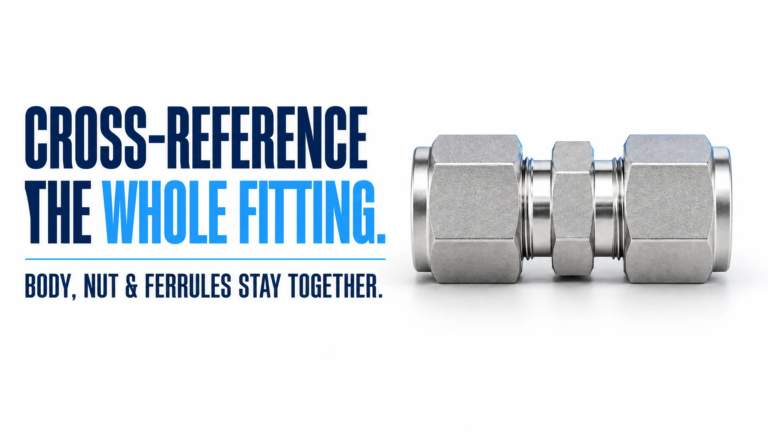
For a stores function that means stocking by family, not by size alone. Two bags marked 1/2 inch from two makers are two different items. Where a panel was built with one brand and you want spares from another, the honest route is a cross-reference by form, fit and function taking the whole joint: nut, body and set from one source. Our cross-reference page exists for that, and the assemblies sit under tube fittings.
Three ways a ferrule shelf goes wrong, none of them exotic.
The mixed bin
Loose ferrules from several makers and sizes tipped into one drawer. Nobody can separate them by eye, so the drawer gets binned.
The orphan front
Sets opened for one half only. The shelf shows stock on paper and delivers nothing at the joint.
The unlabelled bag
A set decanted into a plain bag with a marker scrawl that rubbed off. Guessing size and series at a live panel is not a decision anyone should make.
Size the shelf to the panel, not the catalogue
Start from the panel. Pull the bill of materials and count compression joints by tube outside diameter. Most panels live on two or three sizes, with one carrying the bulk of the joints. Those deserve sets on the shelf. The single odd joint on a size that appears nowhere else is a candidate for ordering when needed.
Then ask which joints actually get broken. Instrument takeoffs and sample points come apart regularly. A buried union mid run, or an elbow behind a bracket, may never be touched. Weight your holding towards the joints your own work orders keep visiting. That also settles material: a corrosion-resistant 316 stainless steel set for the general case, a separate line only where a service demands otherwise, confirmed per order.
Storage and labelling that survives a night shift
Keep sets in their original packaging as long as possible, because it already carries size, material and part reference. If a pack must be split, split it into single set bags and write the label before the parts go in. Sealing surfaces are small and finely finished, so a drawer shared with swarf and drill bits produces leaks. Superior Fluid Solutions lists Superlok® fittings with the finest interior surface finish of any tube and pipe fitting on the market, which only counts if the spare on your shelf has not been rattling against a hacksaw blade since March.
Store sets beside the fittings they serve, not in a separate consumables aisle. If the tees and connectors for a panel share a bin, the sets belong in that bin, marked with the panel tag. That removes the two questions a technician cannot answer at the rack: what size is this, and is it the same make as what is fitted.
| Field | What to write | Why it matters |
|---|---|---|
| Tube OD and unit | The size with “in.” or “mm” spelled out | A bare number invites the wrong unit system at the joint |
| Brand and series | The maker and fitting family the set belongs to | Sets are not interchangeable across makers |
| Material | The alloy or polymer as listed on the item | Service compatibility is a material question, confirmed per order |
| Set count | How many complete pairs remain in the bag | Stops a half used pack reading as full stock |
| Panel or job tag | The rack, skid or loop the set was bought for | Puts the set back at the joint it was meant for |
A labelling convention, not a specification. Material grades, pressure ratings and certification are confirmed per order.
What to put on the purchase order
An order a supplier can fill without a phone call carries five things: tube outside diameter with its unit, the fitting family and brand, the material, the number of complete sets, and the pack multiple you will accept, since some makers ship on arbors of ten. Add the material documentation you need on site, which you can check against the certifications page, and name the job so the goods inwards label writes itself. Buying through a channel, our distributors page covers routing.
Buying questions we get asked
Do I need a new set every time a joint comes apart?
Not as a rule. Swagelok® states its tube fittings may be disassembled and reassembled many times, and ordinary remakes reuse the ferrules already on the tube. Specific procedures do call for discarding them, and damaged ferrules should not be argued with. Hold stock for those cases.
Can I buy just the front ferrule?
The catalogue pattern across makers is front and back together, in pack multiples. Buying halves leaves singles that cannot complete a joint, which is worse than nothing because the stock record still shows a number.
Will a set from one brand work in another brand’s fitting?
Treat it as out of bounds. No common standard governs tube fitting geometry, so tolerances and finishes differ and a mixed assembly is unvalidated. To change supply, cross-reference the complete fitting by form, fit and function and replace nut, body and set together.
How many sets should we hold?
Derive it from your own drawings and work order history. Count joints by size, identify which ones your team actually breaks, and hold against those. We will not publish a number, because a number that ignores your panel is a guess dressed as advice.
Is stainless steel the only option?
Ferrule sets are listed in 316 stainless steel, and other materials appear in manufacturer catalogues for particular duties. Which one suits your service, and what documentation comes with it, is confirmed per order.
Ferrule sets, sized and listed
Pick the size, the material and the family, and keep the shelf honest.
Superior Fluid Solutions
Spares that arrive labelled, sized and matched.
Sources
- Swagelok®, “316 Stainless Steel Ferrule Set (1 Front Ferrule/1 Back Ferrule) for 1/4 in. Tube Fitting, Order in multiples of 10,” manufacturer product listing, accessed September 2026. Supports that ferrule sets are catalogued as one front and one back ferrule for a single tube size, in 316 stainless steel, ordered in multiples of ten. products.swagelok.com
- Swagelok®, “An Installer’s Pocket Guide for Swagelok® Tube Fittings,” MS-13-151, manufacturer publication. Supports that these fittings may be disassembled and reassembled many times, and that a removal procedure instructs the installer to discard the ferrules. swagelok.com
- Jon Kestner, “Why You Shouldn’t Use Tube Fittings from Different Manufacturers in the Same System,” Machine Design, 10 August 2023. Supports the definition of intermix across nuts, ferrules and bodies, and the absence of an industry wide tube fitting standard. machinedesign.com
- Parker®, “Front and Back Ferrule Sets for Single and Two Ferrule Tube Fittings,” manufacturer product list, accessed September 2026. Supports that a second manufacturer also catalogues front and back ferrule sets for its own tube fittings in fractional and metric tube sizes with a minimum order quantity of ten. ph.parker.com
Technical note: the sources above are manufacturer product listings, a manufacturer installation guide and an engineering trade article. Together they establish how ferrule sets are packaged and sold, that reassembly of a tube fitting is normally permitted, that some procedures require discarding ferrules, and that mixing components across makers creates an unvalidated assembly. They do not establish any holding quantity, price, lead time or availability, none of which appear here, and they prove nothing about the condition of parts already installed on your panel. Material grade, pressure rating and certification for any item are confirmed per order.
Trademark disclaimer: Swagelok® is a registered trademark of Swagelok Company. Parker® is a registered trademark of Parker Hannifin Corporation. Superlok® is a registered trademark of its owner. All other marks belong to their respective holders. Superior Fluid Solutions is not affiliated with, endorsed by or sponsored by any of these companies. Cross-references are made by form, fit, and function only.