
Superior Fluid Solutions · Cross-Reference
BI-LOK® vs Swagelok®: Pull-Up, Gauging and Reassembly
Two double ferrule fittings can look alike on a bench and still come with separate instruction sheets that were never written to be swapped.
Pull-up, gauging and reassembly are three separate disciplines, and a double ferrule fitting arrives with all three written down by whoever manufactured it. According to Swagelok®’s installer’s pocket guide, MS-13-151, a manufacturer publication, the instruction for 1 in. and smaller is to “tighten the nut one and one-quarter turns to the 9 o’clock position,” while the smallest sizes get “three-quarters turn to the 3 o’clock position” and anything above 1 in. gets “one-half turn to the 12 o’clock position.” BI-LOK® is Ihara Science’s double ferrule line, described on the manufacturer’s own site as fittings that “provide leak free seals in process, power, and instrumentation applications.” What matters for a rebuild is not whether the two look similar in a drawer. It is that each family’s turns, gauge and remake procedure are published by its own maker, for its own parts, and travel together.
Pull-up: seating the ferrule the first time
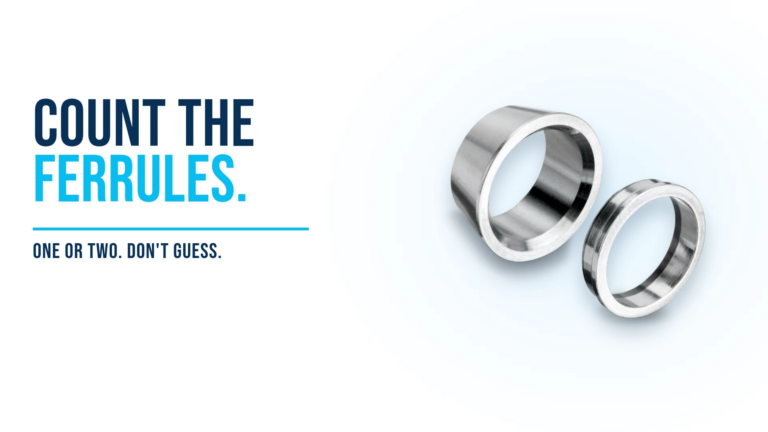
Pull-up is the first tightening past finger tight, the pass that drives the ferrules onto the tube and into the body. Both of the documents behind this post express it as wrench turns against a clock face rather than as a torque value, because torque on a ferrule joint varies with lubrication and surface condition in ways a turn count does not. Swagelok®’s guide sets three tiers by size, three-quarters of a turn for the smallest tubes, one and one-quarter turns through the middle of the range, and half a turn above 1 in., each measured from a starting mark. It adds a separate instruction where the system is high pressure or carries a safety factor: “further tighten the nut until the tube will not turn by hand or move axially in the fitting.” Any brand you are holding has its own version of those numbers, issued for its own ferrules and its own body taper. Read the sheet that came with the part rather than the one you happen to remember.
Gauging: checking pull-up without taking it apart
A gap inspection gauge is a thin blade that goes into the space left between nut and body after tightening. Swagelok®’s guide says its own gauge exists to assure an inspector that the joint “has been sufficiently tightened” on first assembly: if the blade slips in, the joint wants more; if it will not enter, the pull-up is judged complete. The same document draws a hard line around that use, instructing plainly, “Do not use the Swagelok gap inspection gauge with reassembled fittings.” The gap left after a remake is not the gap a first pull-up leaves, so the tool stops answering the question it was made for. That limit is worth carrying across any brand you work on, because it is a statement about what a gap measurement can and cannot tell you, not about a logo.
| Step | Swagelok®’s own published instruction | What to confirm for the part you are actually holding |
|---|---|---|
| First pull-up, smallest sizes | 3/4 turn, to a 3 o’clock mark | The turn count on that maker’s own instruction sheet for that size |
| First pull-up, mid range | 1-1/4 turns, to a 9 o’clock mark | Whether the count is quoted from finger tight or from a marked position |
| First pull-up, above 1 in. | 1/2 turn, to a 12 o’clock mark | Whether the maker publishes a separate tier at all above 1 in. |
| Gauge check | Initial installation only, expressly not on reassembled fittings | Which gauge that maker specifies, and what it is rated to check |
| Remake | Mark, return to the marks, feel for resistance, then tighten slightly | Whether any remake limit is published for that part, in writing |
The middle column is Swagelok®’s instruction for Swagelok® fittings, quoted from its own guide. The right-hand column is what a buyer has to establish independently for whatever brand is on the rack. Nothing in either column licenses combining parts from two makers in one joint.
Reassembly, and why the joint stays single-sourced
On a remake, Swagelok®’s guide replaces the turn count with a procedure. Before anything comes apart, “mark the tube at the back of the nut; mark a line along the nut and fitting body flats.” On the way back together, the preswaged tube goes in and the nut returns to those marks, at which point, the guide says, “you will feel a significant increase in resistance,” followed by a slight further tightening. No fixed number of remakes appears in that document, and we have not found a published count elsewhere, so we are not going to invent one. A second Swagelok® document, its reassembly instructions for well control equipment, MS-CRD-0275, states the boundary this whole post sits inside: “Do not mix/interchange Swagelok products or components not governed by industrial design standards, including Swagelok tube fitting end connections, with those of other manufacturers.” That is the manufacturer writing about its own parts, and it happens to describe exactly how we handle every brand that crosses the counter.
What Superlok® says about Superlok® is this: the finest interior surface finish of any tube and pipe fitting on the market, said of its own product and taken as such here. The fittings are listed in 316 stainless steel, an austenitic, corrosion-resistant choice that tolerates being opened and remade for calibration work. Pull-up turns, gauge use and remake practice all come from the instruction sheet issued for the exact part, with the order. Look through the ferrule sets we hold as matched sets, the wider tube fittings catalog, the connectors that carry the same nut and ferrule arrangement, our certifications record, and a neighbouring comparison in our Hy-Lok® piece.
Questions about pull-up, gauging and reassembly
If two brands publish a similar turn count, can their parts share a joint?
No. A matching number in two books is not evidence that two ferrule geometries deform the same way, and Swagelok®’s own reassembly document tells installers not to interchange its components with other makers’. We apply that rule in both directions, for every brand.
Can I put one maker’s gap gauge on another maker’s fitting?
Use the gauge the manufacturer of that fitting specifies, and use it only for what that manufacturer says it checks. Swagelok® restricts its own gauge to first installations and rules it out on anything reassembled, whoever built the part.
How many remakes is a double ferrule joint good for?
Neither document behind this post prints a number. Swagelok® substitutes a procedure, mark the position, come back to the marks, feel the resistance rise, then nip it up. We are not going to publish a figure we cannot source.
Why keep every piece of one joint from a single manufacturer?
Because the turns, the ferrule profile, the body taper and the gauge were designed as one set and published as one set. Splitting them mixes two design intentions in a pressure boundary, which is not a risk worth taking to save a part.
What do you need to cross-reference a fitting for a rebuild?
Tube size and wall, the material, and whatever is legible on the nut or body. Superlok® pull-up and gauging instructions go out with the matched part, per order.
Tell us what is stamped on the nut
We will name the part and send the pull-up and gauging sheet that belongs to it.
Superior Fluid Solutions
One joint, one brand, one instruction sheet.
Sources
- Swagelok, “An Installer’s Pocket Guide for Swagelok Tube Fittings,” MS-13-151 (manufacturer publication), supports the quoted pull-up turn counts and clock positions by size, the quoted high-pressure instruction, the quoted purpose of the gap inspection gauge, the quoted prohibition on using it with reassembled fittings, and the quoted marking and resistance steps of the remake procedure. swagelok.com
- Swagelok, “Tube Fitting Reassembly Instructions for Well Control Equipment Systems,” MS-CRD-0275 (manufacturer publication), supports the quoted instruction not to mix or interchange its products or components, including tube fitting end connections, with those of other manufacturers. swagelok.com
- Ihara Science, fittings product page (manufacturer publication), supports that BI-LOK® is Ihara Science’s double ferrule tube fitting line and the quoted description of it providing “leak free seals in process, power, and instrumentation applications.” iharascience.com
Technical note: the sources above establish one manufacturer’s own published pull-up turns, gauge limits and remake procedure, and identify the other brand’s line and the applications its maker publishes for it. They do not establish a turn count, a gauge method or a remake limit for any other manufacturer’s fitting, they do not establish that fittings, ferrules or nuts from two makers may be assembled into one joint, and no fixed number of remakes is claimed here because none was found in the documents read. Superlok® pull-up, gauging and reassembly instructions are confirmed per order.
Trademark disclaimer: Swagelok® is a registered trademark of Swagelok Company. BI-LOK® is a registered trademark used to identify tube fittings of Ihara Science Corporation. Hy-Lok® is a registered trademark of Hy-Lok Corporation. Superlok® is a registered trademark of BMT Co., Ltd. Superior Fluid Solutions is not affiliated with, authorized by, endorsed by or sponsored by any of these companies, and the marks are used here only to identify the products they name. Cross-references are made by form, fit, and function only.