
Superior Fluid Solutions · Cross-Reference
Brennan vs Swagelok®: Hydraulic Ends and Instrumentation Ends
A 37 degree flare and a compression ferrule solve two different sealing problems, and the drawing should tell you which one you are looking at.
A 37 degree flare and a two-ferrule compression sleeve are answers to two different questions, and confusing them is a quick way to put a hydraulic end where an instrument end belongs. According to the American National Standards Institute’s listing for SAE J514, Hydraulic Tube Fittings, a standards body publication, the standard “covers complete general and dimensional specifications for 37 degree flared and flareless types of hydraulic tube fittings and O-ring plugs,” and states that those fittings “are intended for general application in hydraulic systems on industrial equipment and commercial products.” Brennan Industries is a fittings manufacturer whose own site claims “over 120,000 different fitting styles” alongside “engineered specials and built-to-print parts.” Swagelok®’s gaugeable tube fittings catalog, a manufacturer publication, describes something built for a different job: two ferrules that “separate sealing and tube gripping functions,” where “each ferrule is optimized for its function.” Neither design stands in for the other, because neither is solving the other’s problem.
Where a hydraulic end belongs
Flared and flareless hydraulic ends are the working vocabulary of power circuits: cylinders, pumps, hose assemblies, valve blocks and manifold ports on industrial and mobile equipment. The standard behind them says so in its own scope, naming industrial equipment and commercial products as the intended field. A 37 degree flared connection takes its seal from the cone formed at the tube end, with a nut drawing that cone against a matching seat, metal against metal, no elastomer doing the sealing. A straight-thread O-ring boss end works differently again, holding pressure at a seal in the boss rather than on the thread, and appears at ports rather than between two lengths of tube. What the whole family has in common is the duty it was written for: the pressures, the vibration and the hose movement of power transmission.
Where an instrumentation compression end belongs
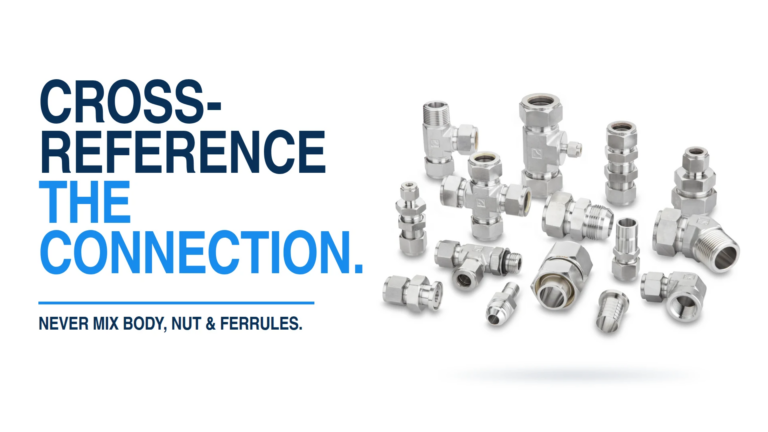
An instrumentation compression fitting answers a narrower and much calmer question: a rigid metal tube, usually stainless steel, running to a gauge, a transmitter, an analyzer or a sample point, where what is wanted is a leak-tight joint that can be opened and closed again for calibration without ruining the tube. Swagelok®’s catalog puts the mechanism in one line, dividing the work between two ferrules so that neither has to do both jobs: the back ferrule “axially advances the front ferrule” and “radially applies an effective tube grip,” leaving the front ferrule to make the seal. That is a fitting designed to be gauged on assembly and taken apart again, on tubing that is not flexing the way a hose does. Putting a hydraulic end into that service, or a compression end onto a power line, is not a question of one being better. It is a question of which end was drawn for the joint in front of you.
Three places the two families do not swap, even where an adapter could physically join them.
Movement and vibration
A power circuit moves. The standard for flared hydraulic ends is written around that duty. A ferrule joint on rigid tube is not qualified for the same flexing, and nothing in its literature claims it is.
Where the seal actually sits
One family seals at a cone formed on the tube end. The other seals at a ferrule bearing on the tube wall. Adapting between them relocates the pressure boundary, which is not a decision to improvise on a ladder.
Being opened again
Instrument joints get broken for calibration and remade to a published procedure. Hose ends are not built around that cycle, and treating them as if they were shortens their life.
| Characteristic | Flared or flareless hydraulic end | Instrumentation compression end |
|---|---|---|
| Published governing document | SAE J514, covering 37 degree flared and flareless types | Each manufacturer’s own dimensional catalog |
| Seat of the seal | At the flare cone, metal against metal | At the front ferrule, on the tube wall |
| Field the standard names | Hydraulic systems on industrial equipment and commercial products | Gauge, transmitter, analyzer and sample tubing |
| Taking it apart | To the hose and fitting maker’s instructions | To that maker’s published pull-up and gauging procedure |
Every entry here describes a family of ends in general terms, drawn from the standard and the catalog cited below. Nothing in the table says a part built to one family can take the place of a part built to the other, and nothing in it compares one manufacturer against another.
Superlok® makes a surface-finish claim of its own about its own instrumentation line, the finest interior surface finish of any tube and pipe fitting on the market, strictly a machining claim rather than a claim about duty. Those fittings are listed in 316 stainless steel, the corrosion-resistant default for analyzer and gauge tubing. Where a drawing calls for an instrumentation end, grade, working pressure and certification are all fixed at the order stage; where it calls for a hydraulic end, that is a different product and outside anything a compression fitting cross-reference should touch. Our tube fittings and pipe fittings cover the instrument side, with nipples for the threaded run into a tap, ball valves for isolation on the same hookup, and our oil and gas piece for a plant where both duties share a skid.
Buying questions about hydraulic and instrumentation ends
Can a hydraulic flared end be adapted onto an instrument tube run?
Adapters exist between most end types, but the first question is what the run is for. A power line and a sample line carry different expectations for movement, for being taken apart, and for calibration, and the end type on the drawing usually reflects those.
Is a 37 degree flare a kind of compression seal?
No. The flare seals at a cone formed on the tube itself, drawn into a matching seat. A compression fitting seals at a ferrule pressed onto the outside of the tube. Different surfaces, different standards, different duty.
Why does Brennan Industries sit on the hydraulic side of this comparison?
Its own published range is a broad catalog of fittings and adapters for fluid power work rather than an instrumentation tube fitting line, so the ends it stocks reflect the market it serves. That is a description of focus, not a ranking.
How do I tell which family my drawing actually calls for?
Read the callout rather than the size. A hydraulic callout points at a thread size and a flare or boss standard. An instrumentation callout points at a tube outside diameter and a wall thickness. If it is ambiguous, measure the part that is already fitted.
Name the duty before the size
Tell us whether the line carries power or carries a measurement, and we will point at the right range.
Superior Fluid Solutions
Two duties, two vocabularies. Do not blend them.
Sources
- American National Standards Institute, catalog listing for SAE J 514, “Hydraulic Tube Fittings” (standards body publication), supports the quoted scope covering 37 degree flared and flareless types of hydraulic tube fittings and O-ring plugs, and the quoted statement that these fittings are intended for general application in hydraulic systems on industrial equipment and commercial products. webstore.ansi.org
- Swagelok, “Gaugeable Tube Fittings and Adapter Fittings,” MS-01-140 (manufacturer publication), supports the quoted separation of sealing and tube gripping between two ferrules, the quoted statement that each ferrule is optimized for its function, and the quoted description of the back ferrule axially advancing the front ferrule and radially applying an effective tube grip. swagelok.com
- Brennan Industries, company home page (manufacturer publication), supports the quoted claim of over 120,000 different fitting styles and of engineered specials and built-to-print parts, and shows the company writing its name without a registered trademark symbol. brennaninc.com
Technical note: the sources above establish what the governing hydraulic fitting standard says it covers and what it says those fittings are for, how one instrumentation manufacturer describes the mechanism of its own two-ferrule design, and the breadth of range one hydraulic fitting manufacturer publishes for itself. They do not establish a pressure rating for any end type, they do not establish that a part from one manufacturer performs the same as a part from another, and they do not establish that hydraulic and instrumentation ends may be substituted for one another. Superlok® grade, working pressure and documentation are confirmed per order.
Trademark disclaimer: Swagelok® is a registered trademark of Swagelok Company. Brennan Industries is a trade name of Brennan Industries, Inc., which does not mark it with a registered trademark symbol on its own site. Superlok® is a registered trademark of BMT Co., Ltd. Superior Fluid Solutions is not affiliated with, authorized by, endorsed by or sponsored by any of these companies, and the marks are used here only to identify the products they name. Cross-references are made by form, fit, and function only.