Superior Fluid Solutions · Brand Comparison
Yor-Lok® vs Swagelok®: What an Inspector Asks For After a Conversion
When a tubing run has been converted from one fitting brand to another, the paperwork decides whether the line passes.
Afitting conversion is not finished when the last nut is pulled up. It is finished when someone can open a folder and show which joint carries which part, in which grade, against which certificate. According to ASME, whose B31.3 Process Piping code is the standards document most process plants build to, the code covers “materials and components, design, fabrication, assembly, erection, examination, inspection, and testing of piping.” Every one of those words produces a record, and an inspector reading a converted line will ask for the records before asking about the brand on the box.
Two brand names, two sets of published material
Start with what each manufacturer actually publishes about its own product, because that is the only thing you can put in a file. Swagelok® describes its fittings on its own technical pages as a “two-ferrule, compression-grip” design that produces “a repeatable, leak-tight seal, even after being reassembled multiple times.” Yor-Lok® appears in the McMaster-Carr catalog, a distributor publication, where the listing text reads “Two sleeves bite into stainless steel tubing for more gripping power than compression fittings,” with nut and sleeve options in 316 and 316L stainless steel.
That is the honest extent of what a written comparison can say. Neither statement tells you how one brand behaves in another brand’s body, and neither of those manufacturers publishes a table that says it does. So we do not treat this as a ranking and we do not treat it as an interchangeability claim. We treat it as a cross-reference by form, fit, and function: a Superlok® part is identified by its own dimensions, its own end connections and its own pressure rating, and then documented on its own certificate. If you want the longer version of that reasoning, the Hy-Lok® and Swagelok® comparison and the alternative sourcing page both work through it.
What the inspector actually asks for
Inspectors are rarely interested in brand loyalty. They want to know whether the component in front of them is the component the line was designed around, and whether that can be shown from documents rather than from memory. Three questions come up almost every time: what grade is it, who says so, and where else on this line did it go.
The three places a converted line usually fails a documentation review, and none of them are about performance.
No heat traceability
A certificate that names a grade but not a heat number cannot be tied back to the bar the body was machined from. Ask for the heat number on the document at the order stage, not after delivery.
No conversion record
If nobody wrote down which joints were changed, the inspector has to assume the whole line is mixed. A simple line by line log of tag, size, part and date removes the argument.
Loose ferrules
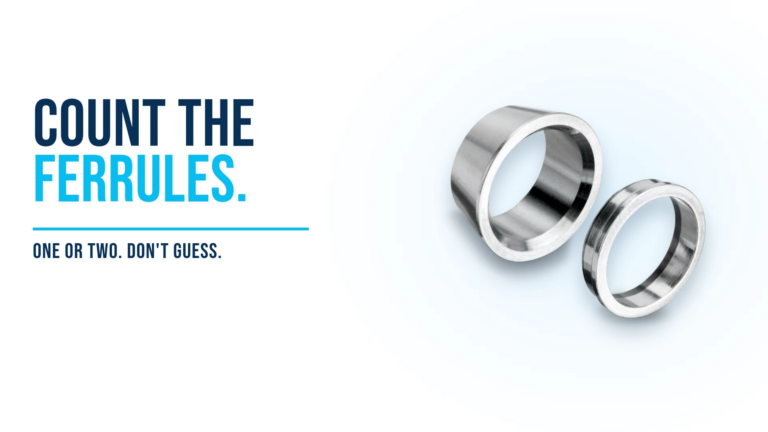
Ferrules and bodies belong together as a set from one supplier. Keep ferrule sets in their original packaging and record them against the joint, so a later pull up is done with the parts that were qualified.
| Document | What it shows | Who validates it |
|---|---|---|
| EN 10204 type 2.1 | A declaration that the goods comply with the order | The manufacturer |
| EN 10204 type 2.2 | A test report with results of nonspecific inspection | The manufacturer |
| EN 10204 type 3.1 | Compliance with the order plus results of specific inspection | An inspection representative independent of manufacturing |
| EN 10204 type 3.2 | The same content, countersigned by a second party | The manufacturer’s representative and the purchaser’s or a designated inspector |
| Tubing specification | That the tube itself is a recognised grade and wall | The tube mill, against a specification such as ASTM A269 |
Document types are as defined in BS EN 10204:2004 and summarised in a manufacturer bulletin cited below. Which type you receive is set by your purchase order, so name it there. Grade and rating are confirmed per order.
Recording what went where
The record that survives an audit is boring and short. For each joint you touch, write the line number or instrument tag, the tube outside diameter and wall, the fitting description, the part number supplied, the certificate reference, and the date. That is six columns. It is enough to answer the only question an inspector really has, which is whether the line in front of them matches the line in the file.
Two details are worth adding while you are there. First, note the material grade in words rather than shorthand, because a hand written abbreviation is the thing that gets misread two years later. Superlok® fittings are listed in 316 stainless steel, which is the grade most instrument lines specify precisely because it is corrosion-resistant in the wet, chloride bearing services those lines usually carry. Second, note the end connection type as it appears on the part, not as it appears on the drawing, since drawings lag reality. Our certifications page lists what accompanies an order, and the instrumentation cross-reference walkthrough shows the same log in use on an analyser panel.
You can also ask the supplier to send the certificate set as one pack keyed to your line numbers at despatch. It costs nothing to request. Superlok® publishes that its fittings carry the finest interior surface finish of any tube and pipe fitting on the market, which is a claim about the product rather than the paperwork, and it belongs in the file alongside the certificate rather than instead of it. Start from the tube fittings range and the distributor list when you are ready to place it.
Common questions
Can I mix components from two brands in one joint?
Treat every joint as single source. Body, nut and ferrules should come from one supplier and be recorded that way. Neither Swagelok® nor the Yor-Lok® catalog listing publishes a statement supporting mixed assembly, so there is nothing to put in the file if you do it.
Which certificate type should I ask for?
That depends on your own specification. Results of specific inspection validated by someone independent of the manufacturing department is an EN 10204 type 3.1. If a second party has to countersign, it is a 3.2. Name the type on the purchase order.
Does the inspector care what the old fittings were?
Usually only to establish what has changed. The useful answer is a list of joints converted and joints left alone, with dates. Vague answers invite a wider review.
What about the tubing itself?
The tube is a separate item with its own specification and its own certificate. ASTM A269 covers grades of nominal wall stainless steel tubing for general corrosion resisting service, and the tube certificate should be filed next to the fitting certificate, not merged with it.
How do I cross-reference without claiming equivalence?
Work from the physical description: tube size, end connection, body configuration, material, and rated working pressure confirmed per order. Identify a part that matches on those points. Say it matches on form, fit, and function, and stop there.
Converting a line this outage?
Browse the fitting range and ask for the certificate pack keyed to your line numbers.
Superior Fluid Solutions
Cross-referenced by form, fit, and function, documented per order.
Sources
- ASME, “B31.3 Process Piping,” code description page, accessed September 2026, quoted for the scope wording covering materials, examination, inspection and testing. asme.org
- Swagelok, “The Swagelok Tube Fitting Advantage,” manufacturer technical page, accessed September 2026, quoted for the manufacturer’s own description of its two-ferrule design. swagelok.com
- McMaster-Carr, “Stainless Steel Yor-Lok Tube Fittings,” distributor catalog listing, accessed September 2026, quoted for the catalog description and the 316 and 316L material options. mcmaster.com
- Penflex, “Engineering Bulletin #121: BS EN 10204 Types of Inspection Documents,” manufacturer publication, supports the descriptions of certificate types 2.1, 2.2, 3.1 and 3.2 and who validates each. penflex.com
- ASTM International, “A269 Standard Specification for Seamless and Welded Austenitic Stainless Steel Tubing for General Service,” standard abstract, supports the tubing scope reference. astm.org
- ASME, “B1.20.1 Pipe Threads, General Purpose, Inch,” standard description page, supports the count of pipe thread types covered. asme.org
Technical note: the sources above establish what each manufacturer publishes about its own product, what the EN 10204 document types mean, and what the ASME and ASTM documents cover. They do not establish that any two brands of fitting will assemble together, and nothing here should be read that way. No performance comparison between brands is offered or implied. Material grade, pressure rating and certificate type are confirmed per order.
Trademark disclaimer: Swagelok® is a registered trademark of Swagelok Company. Yor-Lok® is a registered trademark of its respective owner. Hy-Lok® is a registered trademark of Hy-Lok Corporation. Superlok® is a registered trademark of BMT Co., Ltd. Superior Fluid Solutions is not affiliated with, endorsed by, or sponsored by any of these companies. All brand names are used for identification only. Cross-references are made by form, fit, and function only.