
Superior Fluid Solutions · Cross-Reference
Tylok® vs Swagelok®: Confirming the Envelope on the Drawing
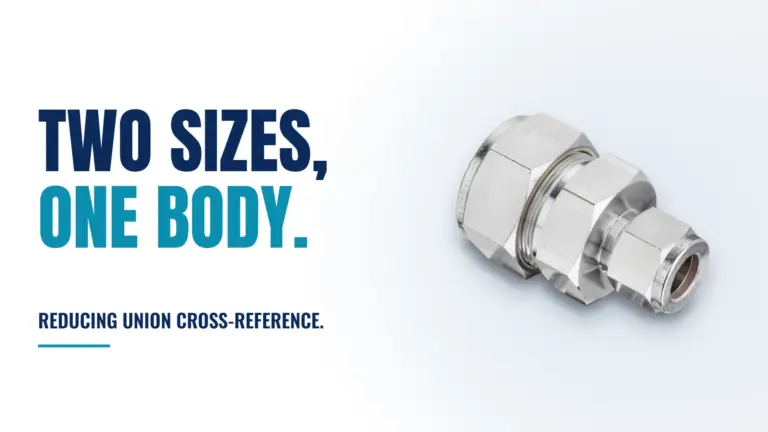
Two unions can share a tube size and a job and still not share a footprint, and the footprint is what decides whether a part fits an existing rack.
A rack built around one manufacturer’s union does not automatically have room for another manufacturer’s union of the same nominal size, and the two catalogs make that case better than any argument could. According to Swagelok®’s own gaugeable tube fittings catalog, MS-01-140, a manufacturer publication, its unions are tabulated by tube outside diameter against dimensions lettered A, D and E, with the basic ordering number 400-6 covering 1/4 in. tube and an A dimension of 1.61 in. Tylok®’s own tube fittings catalog tabulates its 1/4 in. union, part 4-DU in the CBC-Lok® line, with an A dimension of 2.27 in., a body hex of 5/8 in. and a nut hex of 9/16 in. Same nominal tube. Different letters, different column sets, different figures. Working out what actually fits is a measuring job, not a catalog-reading job.
Why the envelope, not the tube size, decides fit
Tube size tells you which tube the fitting grips. It says nothing about how much space the body occupies once the joint is made up, how much room a wrench needs to swing on the flats, or how far the assembly projects past the panel or bracket it mounts against. Those three facts are the envelope, and the envelope is what the rack was built around. Two 1/4 in. unions from two makers can both be correct, fully rated, properly certified parts and still refuse to occupy the same slot.
Look at how differently the two catalogs even describe their own parts. Swagelok® gives each union size three lettered dimensions in the table and puts the wrench flats on the accompanying drawing as “F flat,” outside the size columns. Tylok® runs a wider table: tube outside diameter, an A dimension, a through hole marked E, a body hex marked BH, a nut hex marked NH, and a second nut hex column again. The one place the two happen to agree at 1/4 in. tube is the through bore, which both put at 0.19 in. Everything else is measured and named on each company’s own terms. That is not a fault in either book. It means a letter in one table cannot be laid against the same letter in the other and called a comparison.
What both catalogs tell you about their own numbers
Each company attaches the same warning to its own figures. Swagelok®’s catalog states that “dimensions are for reference only and are subject to change.” Tylok®’s catalog carries a note in almost the same spirit: “Dimensions subject to change, to be used for reference only.” Read that as instruction rather than as legal cover, because it is the correct instruction. A published dimension is a way to sanity-check a drawing, not a replacement for one, and neither company is promising that a figure printed in 2024 is the figure on the shelf today.
Measuring before ordering
Work from the hardware. Put a caliper along the body end to end and write that number down as your own, not as a letter copied out of a book. Measure the flats where the wrench actually goes, and measure the nut flats separately if they differ from the body, because Tylok®’s table shows plainly that a single hex figure need not cover both. Measure the clearance you have: to the panel behind, to the bracket beneath, and to whichever line runs closest, including room to swing a wrench without fouling it. Where a manufacturer’s own dimensional drawing exists, use it to check what you measured rather than to replace it, and note the edition you read, since both catalogs reserve the right to move the figures. Then put all of that on the enquiry instead of the tube size, because tube size is the one thing the two catalogs already agree on.
Superlok® claims the finest interior surface finish of any tube and pipe fitting on the market, its words about its own part, repeated here as nothing more than that. The range is listed in 316 stainless steel: corrosion-resistant, and hard-wearing on the panels and brackets these parts bolt through. Body length, hex sizes, grade and working pressure are all pinned down per order against the figures you measured. See the unions we carry, the reducers and adapters that often absorb a rebuild, our certifications record, and the Hy-Lok® comparison where we work a neighbouring brand the same way.
| What the catalog publishes | Swagelok® MS-01-140 | Tylok® tube fittings catalog |
|---|---|---|
| Reference for 1/4 in. tube | Basic ordering number 400-6 | Part 4-DU, CBC-Lok® line |
| A dimension | 1.61 in. | 2.27 in. |
| Through bore | 0.19 in., lettered E | 0.19 in., marked E thru hole |
| Wrench flats in the table | Not tabulated; marked F flat on the drawing | Body hex 5/8 in., nut hex 9/16 in. |
| Status of the figures | “for reference only and are subject to change” | “subject to change, to be used for reference only” |
Each column is that company’s own published table for its own part. The two catalogs do not define their letters against the same features, so the A row is two separate statements rather than one comparison, and neither row is evidence that a part from one column can stand in for a part from the other. Check the current edition, or the part itself.
Buying questions about confirming the envelope
Same tube size. Will it drop into the same gap?
Not reliably. Tube size settles what the fitting grips, not how long the body is or how wide the flats are. The two catalogs quoted here publish different figures and even different column sets for a 1/4 in. union.
Can I compare one catalog’s A dimension with the other’s?
Treat them as two separate statements. Neither company defines its letters against the other’s, so there is no guarantee both A dimensions are measured between the same two features. Measure the part if the space is tight.
Where do I get envelope figures for something already installed?
If a stamping identifies the maker, start with that maker’s current dimensional catalog. If it does not, take the numbers yourself: body length, the flats, and the clearance all round.
Why do both catalogs say their dimensions are for reference only?
Because a catalog is a snapshot and tooling changes. Both companies say so in print, which is a reason to check the edition date and the physical part rather than to distrust either book.
What should reach us for a dimensional cross-reference?
Measured body length, the wrench flats, the tube outside diameter and wall, and a note on panel or bracket clearance where space is short. We work from what you measured.
Give us three numbers
Body length, wrench flats, tube size. That is enough to start on.
Superior Fluid Solutions
A rack remembers the footprint, not the brand.
Sources
- Swagelok, “Gaugeable Tube Fittings and Adapter Fittings,” MS-01-140 (manufacturer publication), supports the union table lettered A, D and E, the basic ordering number 400-6 with an A dimension of 1.61 in. and a lettered E of 0.19 in. at 1/4 in. tube, the wrench flats marked F flat on the drawing rather than in the table, and the quoted note that dimensions are for reference only and are subject to change. swagelok.com
- Tylok International, tube fittings catalog (manufacturer publication), supports the CBC-Lok® and CS-Lok® line names, the union table columns for tube outside diameter, A, E thru hole, body hex and nut hex, the 1/4 in. row for part 4-DU at A of 2.27 in. with a 5/8 in. body hex, a 9/16 in. nut hex and a 0.19 in. through hole, and the quoted note that dimensions are subject to change and to be used for reference only. tylok.com
Technical note: the sources above are each manufacturer’s own dimensional catalog for a nominally similar 1/4 in. tube union, and they establish only what each company published for its own part at the edition read. The two catalogs use different letters and different column sets, so a figure from one is not a measured equivalent of a figure from the other, and both state their dimensions are for reference only and subject to change. They do not establish that a part from one manufacturer performs the same as a part from another, and they do not establish that components may be assembled together across brands. Superlok® envelope dimensions, grade and working pressure are confirmed per order.
Trademark disclaimer: Swagelok® is a registered trademark of Swagelok Company. Tylok®, CBC-Lok® and CS-Lok® are registered trademarks of Tylok International, Inc. Hy-Lok® is a registered trademark of Hy-Lok Corporation. Superlok® is a registered trademark of BMT Co., Ltd. Superior Fluid Solutions is not affiliated with, authorized by, endorsed by or sponsored by any of these companies, and the marks are used here only to identify the products they name. Cross-references are made by form, fit, and function only.